Posts

Musings and six new pieces
Image
 Painting: I can think of no better reason to keep on keeping on than to accept that it is all rather pointless and one might as well do something. And that's alright: we accept that that is the way things are and there lies freedom. One can step back and see that it is an indulgence, a solitary activity that in itself will change nothing and yet, and yet, although it is a simple thing to imagine not doing, to imagine an empty studio, a studio where I no longer am, it draws me to it again and again and I succumb to its entreaties willingly, eagerly anticipating the heartbreak; the pleasure; the frustration of never being good enough, to balance desire with acceptance.  As the man said: We none of us are going to get out of this alive.

untitled

Image
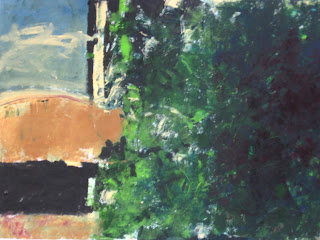
morning. oil on paper 78x65cms garden. oil on canvas 100x100cms Salabert morning ( pink cloud ) oil on canvas 120 x90cms These three paintings seem to be unalike and yet they are worked with the same intention, that of trying to paint what I think about the light and the space. Feeling and seeing are entwined: are we seeing what we feel or feeling what we see ? I have two books to recommend. The first is by Christopher Neeve. Unquiet Landscape Thames and Hudson which is adjudged to be a journey through the imagination of artists in relation to the English landscape. I was lent a copy some time ago by a very good friend and it has taken me until now to obtain my own. The second is Landscape Painting Now, by Barry Swabsky, also T and H. If the thinking is that landscape painting is of little interest then both of these publications ought to challenge that.  

Entangled in the experience.

Image
oil on canvas. 160x 120cms oil on canvas. 120x120cms  My body is entangled within all that I experience:whereforeI believed in believing, I see. My belief is part and parcel of my visual experience and therefore, in order to believe more, I need to see more and to see more completely. Information has come to us via, firstly, an oral tradition and subsequently, much to Plato's distrust, a literary one. Now we are experiencing stories visually and the world is seemingly knowable instantly. Where is the mechanism by which we recognise deception, what tools do we use to avoid manipulation and where is the boundary between truth and lies? How do I, through marks and through colour convey my experience of seeing and make, not an alternative fact, but a truth that is verifiable. That verifiable experience that leads me to see what I feel?

Four paintings at the end of winter.

Image
secure. oil on canvas.160x120cms end of winter. oil on paper. 78x65cms beginning. oil on paper.78x65cms wood. oil on paper.78x65cms  There is a lot to painting that is intuitive: no planning survives first contact with the surface. This though from Peter Lanyon: A specific sight or occurrence may cause an apprehensive reaction, answers are expected. A continuous process of collecting and sifting information which is being fed to the artist who trains to select information which is relevant and proceeds to make marks in apparently automatic fashion. Considerable training is required to precipitate marks which relate to information received. The artist must proceed beyond the inspired guess to certainty. The surest way to inhibit painting is to remain at the guess.

Spirit of place.

Image
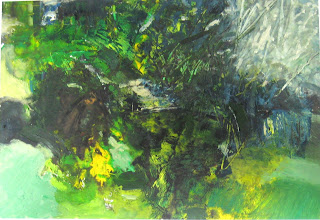
oil on paper. 68x75cms.  oil on paper.68x75cms oil on paper. 68x75cms oil on paper. 68x75cms oil on paper. 69x100cms  My garden is coming alive:the shadows are not strong yet in the sunlight and even on overcast days there is more light. I have a trove of photographs, mostly black and white, which I trawl through when I think that the landscape is exerting too much of a pull. I refer to paintings history for the same reason and it is not a contradiction because I know that I could easily be overwhelmed by what the garden or the fields look like and that is not what I want might painting to become. I do though sail perilously close at times. There is so much detail and so much expanse, too much really and it requires an effort to try to isolate and develop the essentials. So I ask what am I looking at, what am I seeing, what sense can I make of it? Let me not lose sight of the fact that after all is said and done it is paint on a flat surface, a place where thinking can take pl...

Two drawings, one painting in February.

Image
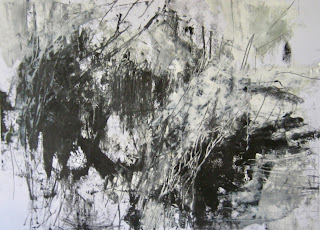
65x78cms. oil, ink, graphite on paper. 65x78cms. oil, ink, graphite on paper. 120x120cms oil on canvas.  There are days when drawing is the main occupation: on some days the drawing begins with no particular direction and my attention is all on the surface and the marks being made. Never the less the exterior of my work space is ever-present and I take my clues from it. Sometimes I address it directly and at others I acknowledge it indirectly through the movements of my wrist, the pressure of my hand. There is no photograph that will place the drawing there, at that place, at that moment but the drawings are all about being there, both inside and out. This painting followed from days of drawing.

Landscape as expression.

Image
oil on paper. 68x75cms oil on paper. 65x78cms To consider landscape painting as a vehicle for expression or for implying that there is inference to be taken from the image is well established and does not need retelling. However, I was interested in a comment from the American painter George Inness who said : Some suppose that landscape has no power of communicating human sentiment. But this is a great mistake. The civilised landscape peculiarly can; and therefore I love it more and think it more worthy of reproduction that that which is savage and untamed. It is more significant. Every act of man, every thing of labor, effort, suffering, want, anxiety, necessity, love, marks itself wherever it has been.  - and then from Patricia Tobacco Forrester; Often the painting develops in a way that I had not anticipated, and I either work at pulling the image back to the original plan, or amplify. the tendencies that have emerged. I scrub out and overpaint as necessary. These paintings that...